.png)

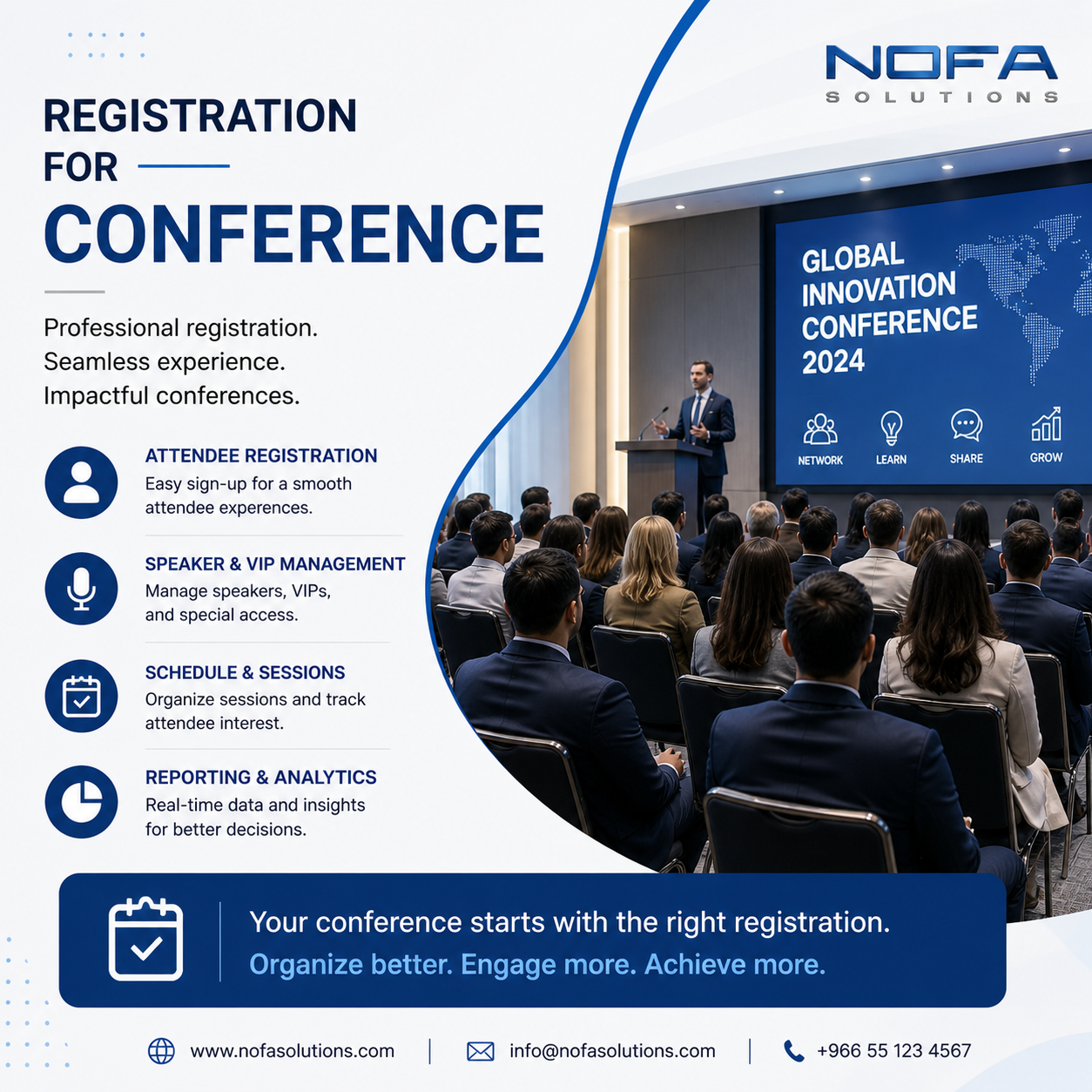
When planning a summit for four thousand people in Riyadh, there is one rule event directors learn very fast: the registration gate is either your biggest asset or your single point of total operational failure.
Exhibition halls in Saudi Arabia don't fill up smoothly. They hit peak ingress like a tidal wave.
Between 8:20 AM and 8:50 AM, roughly 70% of your entire delegate list walks through the front doors at the exact same time. The reasons are simple: morning traffic bottlenecks on the Northern Ring Road, coordinated charter bus arrivals from partner hotels, and the regional preference for arriving immediately before the opening ceremonies begin.
If your gate throughput isn't calculated down to the second, the line stretches into the drop-off lane. Within twenty minutes, VIP guests are trapped in crowds, security marshals get nervous, and the opening keynote starts thirty minutes late to an auditorium that is barely a third full.
We've engineered entrance systems across Riyadh's major venues—including the Riyadh Front Exhibition & Conference Center (RFECC), the King Abdulaziz International Conference Center (KAICC), and the Riyadh International Convention & Exhibition Center (RICEC). Here is the actual technical blueprint for building a high-capacity event registration perimeter that holds up under pressure.
The Math of Morning Ingress: Calculating Your Kiosk Ratio
Most organizers guess how many check-in counters they need. They look at a room layout, see space for six desks, and assume that will be plenty.
That is how disaster starts.
Gate sizing is an exact mathematical formula. Here is the equation we use for every Riyadh deployment:
Take your total expected attendee count—let's say 3,000 delegates. Based on verified historical data across Riyadh business summits, roughly 65% (1,950 attendees) will arrive during the peak 40-minute window between 8:15 AM and 8:55 AM. That requires your registration line to process 48.75 attendees every single minute.
Now calculate transaction latency:
If you run manual check-in desks with laptops and printed attendee sheets, average transaction time per attendee sits between 45 and 65 seconds. A single manual desk processes roughly one attendee per minute. To process 49 attendees per minute, you would need forty-nine fully staffed check-in counters. That's forty-nine laptops, forty-nine operators, forty-nine badge printers, and ninety meters of counter space. No venue lobby has room for that.
Now look at automated self-service thermal kiosks:
An attendee walks up, scans their mobile QR code under a high-speed barcode imager, and a pre-cut direct thermal badge prints in 2.2 seconds. Total transaction time—from approach to badge in hand—is four seconds flat. A single self-service kiosk processes 15 attendees every minute.
To process 49 attendees per minute, you don't need forty-nine desks. You need four self-service kiosks running at full speed. We deploy six to build in a 50% safety margin for edge cases. Peak queue time drops from forty-five minutes down to zero.
Deploying Turnstiles and Speed Gates to Prevent Pass Sharing
At major commercial exhibitions where entry passes cost several hundred dollars, badge sharing is a persistent revenue leak. A registered attendee walks into the hall, takes off their badge, passes it back through the security barrier to an unregistered colleague, and both enter the venue on a single ticket.
To stop this leak, we integrate our registration database directly with optical flap turnstiles and motorized speed gates fitted with anti-passback logic.
Here is how anti-passback works:
When an attendee scans their badge barcode at Turnstile 3, the access controller records their status as 'INSIDE'. The turnstile flaps open, the attendee walks through, and the optical beam confirms entry. If that exact same badge is scanned again at any perimeter entrance within four hours, the barrier remains locked, an audible warning sounds, and the guard's tablet displays a 'DUPLICATE SCAN DETECTED' alert.
The system only resets when the badge is scanned out through an exit turnstile. This single mechanism routinely recovers tens of thousands of dollars in ticket revenue for commercial organizers while providing venue security marshals with real-time, live occupancy counts inside the halls.
Thermal Butterfly Badges: Strong, Professional, and Sustainable
Plastic badge pouches are becoming obsolete across the GCC. They generate massive piles of plastic waste, rip easily at the lanyard punch hole, and spin backwards around delegates' necks so that nobody can read their name.
We deploy dual-sided direct-thermal butterfly badges manufactured from 240 GSM tear-resistant synthetic stock. Here is why this format has become the standard for executive events in Riyadh:
The badge prints flat on a continuous thermal roll. Both the front and back of the badge print simultaneously in high resolution. When the attendee takes the badge, they peel off the release liner and fold the two halves together. The high-tack adhesive bonds the halves into a single, rigid 480 GSM credential that feels like a heavy plastic credit card.
Because both sides print identically, it doesn't matter if the badge turns around while the delegate walks—their name, company, and title are always visible. No plastic pouch is required. The badge incorporates two reinforced lanyard slots that prevent tearing even under strong pulling force. At the end of the event, the paper stock is fully recyclable.
Managing VIP Lounges and Multi-Tier Access Permissions
Large-scale events in the Kingdom rarely operate on a single access tier. An enterprise summit typically incorporates general attendees, VIP delegates, government delegations, media crews, booth exhibitors, and technical contractors.
Your registration architecture must govern permissions across physical zones without causing confusion at the door:
We program our scanners and turnstiles with multi-zone matrix validation. An attendee's registration record contains binary flags for each venue area: Keynote Hall, VIP Lounge, Exhibition Floor, Speaker Green Room, and Press Center. When an attendee approaches the VIP Lounge, the hostess uses a lightweight handheld Android scanner running our access app. The scanner reads the badge in 150 milliseconds. If the record includes VIP clearance, the screen flashes green with the attendee's name and title. If not, the screen flashes red and politely prompts the attendee toward the main hall.
For Royal protocol and ministerial delegations, we build dedicated VIP fast-track hospitality desks located in separate, private arrival lobbys. These counters are staffed by senior bilingual Saudi hosts trained in local protocol. VIP badges are prepared in advance with custom gold-foil embossed lanyards, ready to be presented within five seconds of arrival.
Offline-First Infrastructure: Why Local Servers Save Events
Let's address the elephant in the room: venue internet in the Middle East is notoriously unpredictable during peak event hours.
When thousands of attendees gather in an exhibition hall, their smartphones immediately attach to local cell towers and Wi-Fi access points. The radio spectrum saturates. Even enterprise-grade venue Wi-Fi networks experience packet loss, high latency, and intermittent disconnects during the morning arrival surge.
If your check-in kiosks rely on an active cloud API call to validate a barcode, your gate will freeze the moment the venue connection drops. When the screen displays a loading spinner for fifteen seconds per person, your lines back up into the parking lot.
That is why NOFA Solutions operates an offline-first infrastructure. At every major event, we install an on-premise local server running right behind the registration counters. The local server holds a fully mirrored, encrypted SQLite copy of your entire attendee database. Every kiosk, desk laptop, and turnstile connects to this server through a hardwired Cat6 Ethernet network connected to an industrial PoE switch.
If the venue's fiber optic line gets cut, our gates keep running at 100% capacity without skipping a beat. When the external internet connection restores, our local server automatically runs a two-way synchronization to push scan records back to your cloud dashboard. Zero downtime, zero queue buildup, and zero panic.
ZATCA Phase 2 E-Invoicing Compliance
If your event sells paid conference passes, exhibition booths, or workshop tickets in Saudi Arabia, billing compliance is strictly governed by ZATCA (Zakat, Tax and Customs Authority).
Under Phase 2 of the Fatoorah e-invoicing mandate, organizers cannot simply issue a generic PDF receipt or confirmation email. Every paid registration invoice must be formatted as an approved XML document containing a cryptographic stamp, a sequential UUID counter, the seller's verified VAT registration number, and a Base64-encoded cryptographic QR code.
If an enterprise delegate purchases a SAR 5,000 VIP pass and your system fails to provide a compliant ZATCA tax invoice, their finance department will reject the invoice and withhold payment. Our registration backends link directly to certified ZATCA clearance endpoints. The moment an attendee completes payment on-site or online, their compliant e-invoice is generated and delivered instantly to their email.
Local Payment Processing: Mada and Apple Pay
Over eighty percent of in-person retail and business payments in Saudi Arabia are settled via domestic Mada debit cards or Apple Pay. If your on-site registration counter only accepts international credit card gateways, you will experience a high rate of declined transactions and frustrated attendees.
We deploy certified bank POS payment terminals connected directly to local Saudi merchant acquiring networks. Attendees can tap their Mada card, iPhone, or Apple Watch to pay for on-site passes in under three seconds. Receipts print automatically with the required ZATCA QR code, allowing attendees to walk straight through to badging without waiting for manual invoice generation.
Contractor and Build-Up Credentialing
Event security doesn't start on opening morning; it starts forty-eight hours earlier during exhibition build-up.
During the move-in phase, hundreds of stand builders, AV technicians, carpenters, and logistics drivers need access to the loading docks and exhibition halls. If you don't control contractor access, unauthorized individuals enter the hall, creating severe safety risks and increasing the likelihood of equipment theft.
We establish a dedicated contractor credentialing office at the venue's freight gate. Stand builders must upload worker safety documentation, insurance certificates, and National IDs or Iqamas in advance via our contractor portal. Upon arrival at the loading bay, workers present their verification QR code to receive high-visibility wristbands or temporary barcode passes that grant access only during approved build-up and tear-down windows.
Why Choose NOFA Solutions in Riyadh?
Managing registration for high-profile summits in Saudi Arabia requires specialized hardware, deep local regulatory knowledge, and a battle-tested technical team on the ground.
At NOFA Solutions, we provide the full technology stack: custom online registration websites, ZATCA e-invoicing, self-service check-in kiosks, high-speed thermal butterfly badging, optical turnstiles, and mobile lead retrieval. More importantly, we provide seasoned systems engineers on-site who monitor every gateway, troubleshoot equipment in real time, and ensure your doors open smoothly.
Need High-Capacity Event Registration in Riyadh?
Eliminate lobby queues, secure your hall entrances, and deploy professional self-service badging. Talk with our Riyadh operations directors today.
Talk to Our Riyadh Team